Pursuit was founded in 2011 on a simple mission: economic transformation — leveraging training, relationships, and partnerships to catapult low-income adults into life-changing careers.
One year ago, we made a bold shift in how we pursue it, launching our first AI Native cohort during a period of rapid change in the workforce.
The mission hasn't changed. How we pursue it looks nothing like it did a year ago. This is a recap of our learnings and what's next.

Pursuit has always followed the market. We started with iOS development, shifted to Android, and eventually built our program around full-stack web development, with each transition driven by where the jobs were.
At the beginning of 2025, the market sent a signal we couldn't ignore — and this time, following it meant rebuilding from the ground up. Without compromising our mission, we transform our organization and our training to become AI Native.
Less than two months later, in March 2025, we launched our inaugural AI Native cohort.
This wasn't a new module bolted onto an existing program, or an "AI track" running alongside the old one. It was a ground-up reconstruction of how Pursuit trains, evaluates, and deploys talent — one that preserved our foundational principles while replacing nearly everything else.

- Our trainee-to-instructor ratio grew from 1:30 to 1:100. The role of the instructor evolved accordingly: less lecturer, more coach and culture-builder.
- To make that possible, we built and deployed our own software platform — driving admissions and delivering personalized content and automated feedback at scale.
- Our program length compressed from twelve to seven months, and capstone timelines from three months to under four weeks — because with AI, building software that once took months now takes weeks.
- For the first time, capstone projects were sourced from real industry partners — giving Builders their first experience solving actual client problems, not simulated ones.
We also launched our inaugural SMB pilot with support from Amazon and Google, deploying ten Builders in paid, on-the-job roles for NYC-based SMBs — the next step from project-based work to real employment.

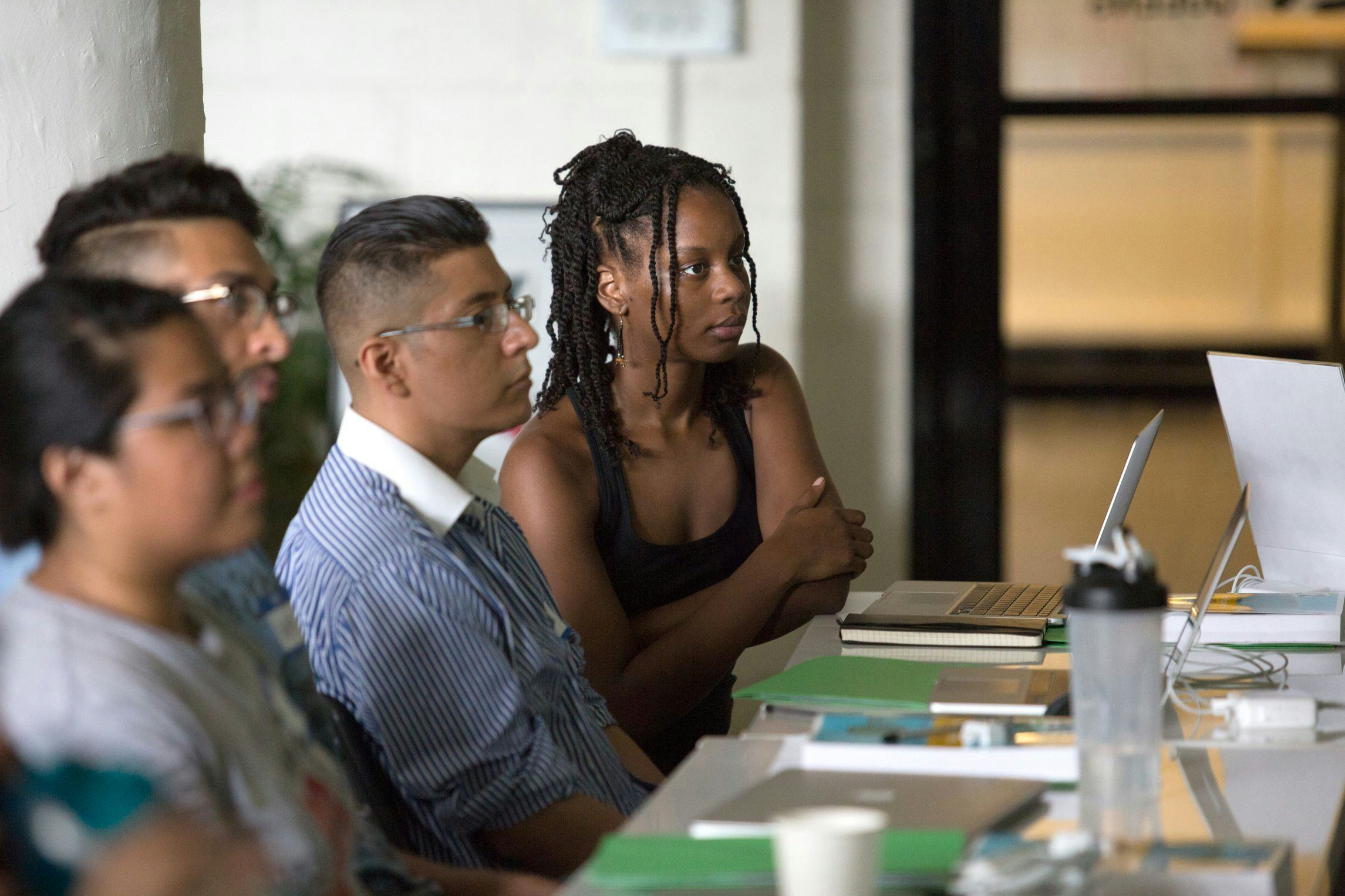
The AI-Native Program inaugural March 2025 cohort on launch day
Our mission: economic transformation for low-income adults.
Our program is delivered entirely in person from our office in Long Island City. The physical space creates the kind of community and accountability that keeps Builders showing up, month after month. There's no virtual substitute.
We rely heavily on industry volunteers — supporting Builders in class, providing one-on-one mentorship, and delivering content that reflects real-world expertise.
The most important skills we teach are not technical. They are the critical thinking, problem-solving, and learning skills that will enable Builders to succeed no matter how tools and technologies evolve.

>325 Builders started their AI journeys with Pursuit in 2025
Since March, we’ve launched three additional AI Native cohorts, with >325 Builders enrolling throughout 2025. Here’s what we’ve learned in that time:
Builders are persisting — and finding meaning in it. In our initial pilot, 79% completed the eight-week training, and 100% of Builders invited to continue through the subsequent five months did. Net Promoter Scores (NPS) are consistently above 50. We believe these outcomes reflect the culture we've built: the way Builders show up for each other, share late nights, and push through hard things together, in person.
It's never been easier to build, and the improvements we've made to the training platform we built would have been inconceivable twelve months ago. The harder challenge is operational: making sure we're actually learning from the data we collect, not just accumulating it.
We've spent a lot of time thinking about AI-generated feedback. Our software generates feedback that rivals what a human instructor can provide — but Builders don't receive and internalize it the same way when they know it's coming from a machine. We're testing strategies to close that gap, but in the meantime we rely on human messengers and interpreters to ensure feedback actually lands.

The speed and quality of what Builders ship continues to surprise us, with noticeable improvements each quarter. But as building gets easier, the challenge shifts: it's no longer about learning to build — it's about developing the taste and critical thinking to build things that actually matter. The most important skill we teach is slowing down: deeply interrogating a problem before touching the keyboard, especially when there's a sycophantic LLM ready to validate any idea they throw its way.
Getting Builders into real projects as early as possible has proven invaluable — for Builders and clients alike. Our scaffolded approach starts with real problems early, then increases complexity and autonomy over time. Two challenges remain: how to operate this model at scale, and how to bridge from paid, project-based work to full-time careers. Both are central to what we're working on in 2026.
The demand signals are strong — our SMB pilot was more than five times oversubscribed. But in many organizations, there's a gap between recognizing the need for AI skills and knowing specifically how to deploy them to drive real outcomes. That gap creates friction in the job market. Closing it will require working both sides: training Builders, and helping employers understand how to find, evaluate, and deploy AI talent. Proof of work is the bridge for both.

The SMB Showcase cohosted by Amazon, Google, Brooklyn Chamber of Commerce, Queens Chamber of Commerce, Asian American Federation and the NYC City Council.
A year ago, we launched our first AI Native cohort. Looking back, the pace of change has exceeded even our expectations — and the acceleration since the start of 2026 has been particularly striking, with new capabilities arriving faster than most organizations can absorb them. That's exactly the environment we've been training for.
Our focus this year is jobs. The momentum is encouraging: Builders are landing paid projects, securing interviews for good jobs, and starting full-time roles.
At the same time, we're continuing to evolve the platform and beginning to explore how multiple agents can work together to support learning in ways that weren't possible even months ago. The technology is moving fast. So are we.

September 2025 Cohort, L1 Celebration.
We’re focused on a few areas where we see the most opportunity:
Expanding our SMB efforts into the nonprofit sector: Piloting embedded AI engineers through initiatives like the AI Nonprofit Build Corps through partnerships with Mizuho and Goldman Sachs, bringing real capability into organizations and applying talent directly to real operating needs
Creating hiring pipelines and apprenticeships into companies, with new partnerships underway: Including early collaborations with leading financial institutions and small and medium businesses.
Formalizing how this model grows: Creating physical hubs and codifying the work through policy and published frameworks to drive systems-level impact
Why this matters: the nature of work is shifting quickly, and traditional pathways aren’t keeping up. These efforts are designed to close that gap—connecting talent to real problems, real teams, and real opportunities.
This is still early. But the direction is clear. We’re continuing to evolve how we deliver on our goal—so more people can access meaningful, high-growth careers.